Written by Safe or Toxic Editorial Team Pharmacy Reviewed by Dimitar Atanasov MPharm · Master Pharmacist | Medication Safety Educator Last Updated: June 2026
Mixing bleach and ammonia is one of the most dangerous things you can accidentally do while cleaning your home. This combination produces toxic chloramine gases that can damage your lungs, cause chemical burns, and in high concentrations, be fatal. As a pharmacist who works with industrial-grade chemicals daily, this is one of the questions I take most seriously — because the danger is real, it happens in ordinary homes, and most people have no idea they are at risk.
Quick Answer
Mixing bleach and ammonia produces toxic chloramine gas instantly. Even small amounts inhaled in a closed space can cause immediate respiratory damage, chest pain, and in severe cases, pulmonary edema — fluid in the lungs that can develop hours after exposure. Never mix these two products under any circumstances. If you have already been exposed, move to fresh air immediately and call Poison Control at 1-800-222-1222.
What Happens If You Mix Bleach and Ammonia?
What Happens When You Mix Bleach and Ammonia?
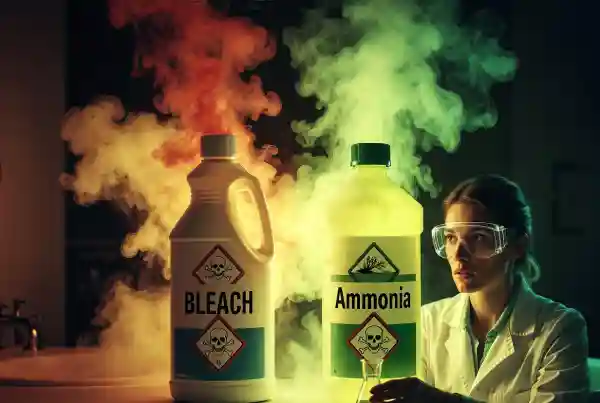
Mixing bleach and ammonia triggers an immediate chemical reaction between sodium hypochlorite — the active ingredient in bleach — and ammonia molecules. The result is chloramine gas, a colorless toxic compound that attacks your respiratory system before you can see or fully smell it coming.
The reaction produces three forms of chloramine gas simultaneously — monochloramine, dichloramine, and nitrogen trichloride — along with small amounts of hydrazine, a known carcinogen. The mixture gets more dangerous in warm temperatures and small enclosed spaces. A bathroom is the worst possible environment for this to happen in.
What makes this especially dangerous is that ammonia hides in products most people do not associate with it. Many glass cleaners, including several Windex formulas, contain ammonia. So do many multi-purpose sprays, some floor cleaners, and certain degreasers. People clean a mirror with a glass cleaner and then wipe the same surface with bleach — and the reaction happens right in front of their face. If you want to understand how bleach reacts with another everyday product, our article on what happens when you mix bleach and vinegar covers an equally dangerous and common combination.
Ingredient Breakdown: What Is Actually Reacting
Table 1 — Chemical Reaction Profile
| Compound | Found In | Role in Reaction | Risk Level |
|---|---|---|---|
| Sodium Hypochlorite | Bleach, disinfectant sprays | Reacts with ammonia to form chloramine | Very High |
| Ammonia (NH3) | Glass cleaners, multi-purpose sprays, floor cleaners | Reacts with bleach instantly on contact | Very High |
| Chloramine Gas | Reaction byproduct | Toxic gas — damages airways and lung tissue | Critical |
| Hydrazine | Secondary byproduct | Known carcinogen formed in smaller quantities | High |
| Nitrogen Trichloride | Secondary byproduct | Irritates eyes, nose, throat, and lungs | High |
Symptoms of Chloramine Gas Exposure
Mild Symptoms
Mild symptoms appear within seconds to minutes and include a sharp burning sensation in the nose and throat, watery and stinging eyes, persistent coughing, and an overwhelming chemical odour similar to a very strong swimming pool smell. Chloramine is actually the same compound that causes the familiar harsh pool smell in poorly ventilated indoor pools.
Moderate Symptoms
Moderate symptoms develop with greater exposure and include chest tightness, shortness of breath, wheezing, nausea and vomiting, and severe eye irritation. If you or anyone in your household reaches this stage, get to fresh air immediately and call Poison Control. Do not wait to see if it improves on its own.
Severe Symptoms — Medical Emergency
Severe symptoms require emergency services immediately. These include severe difficulty breathing, coughing up blood or foamy fluid, blue-tinged lips or fingernails, loss of consciousness, and pulmonary edema — a life-threatening buildup of fluid in the lungs.
The most critical warning here is that pulmonary edema can be delayed by several hours. You may feel noticeably better after leaving the room and then deteriorate rapidly later. Any significant exposure to chloramine gas warrants a medical evaluation even if you currently feel fine. This is not a situation where waiting to see what happens is a safe choice. Understanding the broader danger of inhaling cleaning product fumes is something we cover in depth in our article on whether bleach is toxic when inhaled.
When Should People Call for Help?
Call Poison Control at 1-800-222-1222 immediately if you mixed bleach and ammonia in any quantity — even accidentally, even if you feel fine right now. Symptoms can be delayed and the risk is too serious to monitor at home without guidance.
Call emergency services — 911 in the US, 999 in the UK, 112 in Europe — if anyone has difficulty breathing, chest pain, is coughing up fluid, has lost consciousness, or has blue-tinged lips or fingernails. This is a life-threatening emergency that cannot wait.
Go to an emergency room if you were exposed in a closed space for more than a few seconds, even if current symptoms seem mild. Tell the medical team exactly what products were mixed and approximately how long exposure lasted. Bring the product bottles with you if it is safe to do so.
Do not induce vomiting if the solution was ingested. The chemicals cause additional burns on the way back up. Drink a small amount of water or milk only if Poison Control specifically instructs you to do so.
Exposure Risk by Scenario
Table 2 — What to Do Based on How You Were Exposed
| Exposure Scenario | Risk Level | Immediate Action |
|---|---|---|
| Mixed in a closed bathroom | Critical | Evacuate immediately — call Poison Control and emergency services |
| Mixed in ventilated kitchen | Very High | Leave room — fresh air — call Poison Control |
| Brief accidental mixing then immediate ventilation | High | Fresh air — call Poison Control — monitor for delayed symptoms |
| Surface contact — ammonia cleaner then bleach applied | High | Leave area — ventilate 30 minutes — call Poison Control |
| Skin contact with mixed solution | Moderate–High | Rinse with water for 15 minutes — seek medical advice |
| Eye contact with mixed solution | Very High | Flush with water for 15 minutes — emergency room immediately |
| Outdoor inhalation of drifting fumes | Moderate | Move away — fresh air — monitor symptoms for 4 hours |
Hidden Ammonia — Products You Did Not Know Contained It
This is the section most cleaning safety sites skip entirely, and it is the most important one for preventing accidental exposure in real homes.
Glass and window cleaners are the most common hidden source. Many Windex formulas, most store-brand glass cleaners, and several multi-purpose sprays contain ammonia as their primary cleaning agent. If you wipe a mirror or window with one of these and then disinfect the same surface with bleach, you are creating chloramine gas directly at face level.
Multi-purpose spray cleaners are the second most common source. Look for the words ammonium, ammonia solution, or ammonium hydroxide in the ingredients list. Several widely sold household brands contain these compounds without prominently labeling the product as ammonia-based.
Some floor cleaners and degreasers — particularly products marketed for kitchen grease and heavy-duty floor cleaning — also contain ammonia. Certain oven cleaners combine ammonia with other agents for heavy grease removal.
The safest rule is to treat bleach as incompatible with every other cleaning product unless you have specifically verified the full ingredient list. As we cover in our complete guide to whether household cleaning products are safe or toxic, this single habit prevents the majority of accidental toxic gas exposures in the home.
Safe vs Unsafe Practices
Table 3 — Safe Practices and What to Avoid
| Safe Practice | What to Always Avoid |
|---|---|
| Use bleach diluted in plain water only — 1 cup per gallon | Never mix bleach with any other cleaning product |
| Read labels before using two products in the same area | Never assume a glass cleaner or spray is ammonia-free |
| Rinse surfaces with plain water between different cleaners | Never clean in a closed bathroom with bleach without ventilation |
| Open windows and doors before using any bleach product | Never re-enter a room where mixing occurred for at least 30 minutes |
| Store bleach in a separate cabinet from all other cleaners | Never use bleach near fertilisers — many contain ammonia compounds |
| Call Poison Control immediately if any mixing occurs | Never induce vomiting if the mixed solution is ingested |
Pharmacist Takeaway
In seven years of working with chemistry daily, the bleach and ammonia combination is one I consider genuinely life-threatening in a way that many common household hazards simply are not. The gas forms instantly, it is invisible, it attacks your lungs before you fully register what is happening, and the delayed onset of pulmonary edema means people sometimes walk away feeling fine and deteriorate hours later.
The practical advice I give every person who asks is this: keep bleach completely separate from every other cleaning product in your home, treat every glass cleaner and multi-surface spray as potentially containing ammonia until you have read the full ingredient list, and always open a window before you open a bottle of bleach. No surface is clean enough to be worth a toxic gas exposure.
If you are building a safer cleaning routine from scratch, our guide on whether household cleaning products are safe or toxic gives you the full picture of what to look for on labels and which combinations to avoid permanently.
Bottom Line
Mixing bleach and ammonia produces chloramine gas — an invisible toxic compound that attacks the lungs, eyes, and airways within seconds. There is no safe amount to mix, no safe method, and no situation where it is necessary. Keep the two products permanently separated, read labels carefully to identify hidden ammonia in glass cleaners and sprays, and always ventilate when using bleach alone. If accidental exposure occurs, move to fresh air immediately and call Poison Control at 1-800-222-1222 without waiting for symptoms to worsen.
Frequently Asked Questions – What Happens If You Mix Bleach and Ammonia?
Q: What gas is produced when you mix bleach and ammonia? Mixing bleach and ammonia produces chloramine gas — specifically monochloramine, dichloramine, and nitrogen trichloride depending on the ratio and concentration of both products. The reaction also produces small amounts of hydrazine, a known carcinogen. Chloramine gas is colorless but has a sharp, pungent odour similar to an intensified swimming pool smell and is already causing mucous membrane damage at the concentration your nose can detect it.
Q: How much bleach and ammonia does it take to be dangerous? Very small amounts. Even a tablespoon of each mixed together in a closed bathroom can produce enough chloramine gas to cause immediate respiratory irritation and eye burning. There is no safe threshold for mixing these two chemicals. Any contact between bleach and ammonia should be treated as a toxic exposure event requiring immediate action.
Q: Can the reaction happen on a surface, not just in a bucket? Yes — and this is how most accidental exposures happen. If you clean a surface with an ammonia-containing glass cleaner and then spray the same surface with bleach before it dries, the reaction occurs directly on the surface and releases chloramine gas at face level. Always rinse surfaces with water between different products and allow them to dry fully before applying anything else.
Q: How long do chloramine fumes last in a room? In a completely enclosed room with no ventilation, chloramine gas can persist for 30 minutes to several hours depending on the quantity produced and the room temperature. With windows fully open and good airflow, the gas disperses significantly within 10 to 15 minutes. Do not re-enter a room where mixing occurred for at least 30 minutes even with ventilation running.
Q: What should I do if I accidentally mixed bleach and ammonia? Leave the room immediately without stopping to clean up the spill. Get to fresh air. Call Poison Control at 1-800-222-1222 and describe exactly what happened and how long you were exposed. If you experience difficulty breathing, chest pain, or feel faint, call emergency services immediately. Even if symptoms seem mild, seek medical evaluation because pulmonary edema can develop hours after the initial exposure.
Q: Is it dangerous to use bleach after cleaning with ammonia? Yes. Ammonia residue remaining on a surface will still react with bleach applied afterward. This is why it is essential to rinse surfaces thoroughly with plain water and allow them to dry completely before switching cleaning products. The same rule applies in reverse — rinse bleach residue fully before applying any ammonia-containing product to the same surface.
Q: Can mixing bleach and ammonia be fatal? Yes, in sufficient concentrations in an enclosed space. Deaths from chloramine gas exposure are documented, typically occurring when large quantities are mixed in small sealed spaces. More commonly the outcome is serious lung damage and hospitalisation. Even non-fatal exposures can cause permanent respiratory damage if the person does not receive prompt medical treatment.
Q: Does Windex contain ammonia? Many Windex formulas do — specifically the original Windex Glass Cleaner with Ammonia-D. However, Windex also sells ammonia-free variants. Always check the label before using any glass cleaner near bleach. Look for ammonium hydroxide or ammonia solution in the ingredient list. If you are unsure, treat the product as containing ammonia and keep it away from bleach entirely.
Q: What does chloramine gas smell like? Chloramine gas has a sharp, intensely chemical smell that most people describe as a very strong swimming pool or harsh bleach odour. It is detectable by the human nose at around 0.5 parts per million — a concentration that is already irritating the mucous membranes of the nose and throat. If you smell this odour while cleaning, leave the room immediately.
Q: What is safe to mix with bleach? The only truly safe mixing partner for bleach is plain water. Diluting bleach with water for cleaning is standard practice and safe within recommended ratios — typically one cup of bleach per gallon of water for general disinfection. No other cleaning product should be mixed with bleach. This includes vinegar, hydrogen peroxide, rubbing alcohol, and any multi-purpose spray. Our article on what happens when you mix bleach and vinegar explains in detail why even that seemingly mild combination produces toxic gas.
Medical Disclaimer
The information on this page is for educational purposes only and does not constitute medical or emergency advice. SafeOrToxic content is reviewed by a licensed pharmacist but is not a substitute for professional medical consultation. If you or someone in your household has been exposed to toxic fumes or chemicals, contact emergency services or Poison Control immediately. Do not delay seeking help because of something you read on this website.
Sources
- Centers for Disease Control and Prevention — Chloramine Gas Toxicity — cdc.gov
- National Capital Poison Center — Bleach and Ammonia Mixing Hazards — poison.org
- U.S. National Library of Medicine — Chloramine Inhalation Toxicology — pubmed.ncbi.nlm.nih.gov
- Occupational Safety and Health Administration — Chemical Hazard Communication — osha.gov
- European Chemicals Agency — Sodium Hypochlorite Hazard Profile — echa.europa.eu
- Merck Manual — Chloramine Gas Poisoning — merckmanuals.com
Pharmacy Reviewed By Dimitar Atanasov, MPharm Master Pharmacist | Medication Safety Educator Editorial Policy: Every article on SafeOrToxic is written based on peer-reviewed research, official toxicological databases, and pharmacist expertise. Articles are reviewed for chemical accuracy before publication and updated regularly to reflect the most current safety guidance. Review date: June 2026